For American shoppers, price matters (according to this survey: What matters to you when shopping for groceries?) – but where a product is made may be worth paying extra for. A new WeeklyAdSale.com survey asked U.S. consumers a straightforward question:
“The Value of ‘Made in the USA’: Would You Pay More for U.S.-Made Products?”
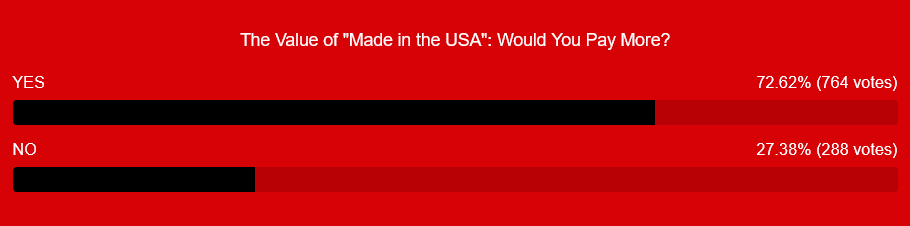
The results show a strong preference for American-made goods. Out of 1,052 votes at the time of writing, 764 respondents (72.62%) said YES, indicating they would be willing to pay more for products made in the United States. Only 288 respondents (27.38%) said NO.
Advertisement:
Survey Results as of August 20, 2026
Advertisement:
The clearest takeaway from the WeeklyAdSale.com poll is the size of the gap between the two groups, with nearly three-quarters of respondents said they would pay more for a U.S.-made product, while slightly more than one-quarter said they would not. That represents a difference of more than 45 percentage points between YES and NO.
The results suggest that, at least among WeeklyAdSale.com survey participants, the “Made in the USA” label can carry real value beyond simply identifying a product’s country of origin.
For many shoppers, buying American-made products may be associated with supporting domestic manufacturing, American jobs and local communities. Others may associate U.S.-made goods with quality, reliability or greater confidence about where and how a product was produced.
The importance of domestic origin in purchasing decisions isn’t unique to this survey. In 2025, the Federal Trade Commission cited polling indicating that 61% of Americans said whether a product was made in the USA played a role in their purchasing decisions.
Keep in mind that Price Still Matters – The survey does not mean that consumers are willing to pay any price for an American-made alternative, because always there is an important difference between saying, “I would pay more,” and being willing to accept a substantially higher price at checkout.
A customer comparing two similar products might be comfortable paying a few dollars more for the American-made product, but that decision becomes much more difficult if the price difference is 20%, 30% or even 50%. That’s particularly relevant for households trying to stretch their budgets and shoppers who regularly use weekly ads, coupons, sales and promotions to lower their expenses.
But What Does “Made in the USA” Actually Mean?
Consumers should consider that an American company or American-sounding brand isn’t necessarily selling a product that qualifies as “Made in the USA.”
Under the Federal Trade Commission’s standard, marketers making an unqualified “Made in USA” claim generally must be able to substantiate that a product is “all or virtually all” made in the United States. That means all significant processing and essentially all significant components must be of U.S. origin.
There are also important differences between phrases customers may encounter.
For example, “Assembled in the USA” can mean that parts originated in other countries but substantial assembly took place in the United States. Similarly, “Ships from the USA” does not mean the product itself was manufactured in America.
The distinction is particularly relevant when consumers are willing to spend extra specifically because they believe their purchase is supporting American manufacturing.
Survey Methodology
The survey “The Value of ‘Made in the USA’: Would You Pay More for U.S.-Made Products?” was conducted on WeeklyAdSale.com and received 1,052 votes at the time these results were compiled (August 20, 2026).
Advertisement:
Respondents selected either YES or NO. The results represent participants in this online poll and should not be interpreted as a scientifically representative sample of the entire U.S. population.